You’ve got a first draft…now what?
Finishing the first draft of your first novel is a big deal. You sat down, day after day, pushing through self-doubt and self-consciousness, and you did the damn thing! Do you know how many people who claim to want to write a book actually finish one? Only 3%.
And now you have this wonderful bundle of potential at your fingertips. When you close your eyes you see launch parties, bestseller lists, Foyles window displays, and a resignation letter thrown in your day-job boss’s face.
Savour this. Lap it all up. Bask in excess optimism, and tuck some away for later. You’re going to need it. Because, and I hate to be the bearer of bad news, your journey to success has only just started. A finished first draft is PHENOMENAL WORK! But it is also just the first step.
Here, I’ll take you through:
What to do as soon as you hit The End
When to get feedback
When to find an editor
How to get ready for querying agents
How to get ready to self-publish
Strap in, because this is going to be a big one!
Put it away
The best thing you can do for your novel is to put it away for a while, and mentally/emotionally detach yourself from it. Being in flow on a piece of work is almost like being tipsy. And if you’ve ever woken up and re-read the Instagram story replies you were firing off last night after too many espresso martinis, you’ll know that it’s probably not your best work.
Putting your novel away helps you to come back to it with fresher, more objective eyes. When you re-read it, it should sound almost like somebody else wrote it. This will help you catch more than just spelling mistakes, revealing your main pitfalls and shortcuts.
For example, when I came back to my first draft of my current manuscript, I noticed how often I talked about where the sun was and what it was doing. It was my go-to for setting the mood of a scene, and it happened at least five times in the first half of the book. Very embarrassing, but I’m glad it was me that caught it, and not a mean Goodreads reviewer.
It’s not all cringe and despair. You’ll learn just as much about your strengths as your weaknesses. There’s something wonderful about laughing at your own jokes, or being pleasantly surprised by a particularly clever line of dialogue. “Did I really write that? Man, I’m good.”
In short, coming back to your novel after some time away will give you a better idea of what a first impression of your work feels like.
Self-edit
It might be tempting at this point to go all-in with beta readers, feedback groups, and professional editing services. With 80% of the editing journey left to go, and with the novel in arguably its roughest shape, shouldn’t now be the time for all-hands-on-deck help?
Truthfully? No.
Self-editing at this stage is the best thing you can do for your writing, for many reasons:
You get to know your story better
You learn more about yourself as a writer
Your learn more about the craft of writing
You push your novel closer to the finish line, without paying a penny
Ultimately, learning how to self-edit will make you a better collaborator for when you are in need of feedback. There’s nothing more frustrating than being given critiques on problems you’re already aware of.
Imagine, you hand your manuscript to a beta-reader, knowing that the first hundred pages are slow and full of exposition, and that the ending kind of ends on a plothole that you’re planning on filling in later. After a nail-biting two weeks, your reader sends you their feedback. They noted that the first hundred pages are slow and full of exposition, and that the ending kind of ends on a plothole. And you think to yourself, “well yeah, I know that!” Getting feedback on a manuscript with issues you haven’t even attempted to take a crack at yourself wastes both your and your feedback-giver’s time.
In general, feedback is best given when you’ve done everything you can by yourself. You’ve tried to pick up the pace, you’ve tried to fill in the plot holes, and you’ve gone over every sentence to make sure it sounds the way it did in your head when you were daydreaming about the scene on your morning dog walk. Once you’ve done that, outsider perspectives become invaluable in helping you decide where to go next.
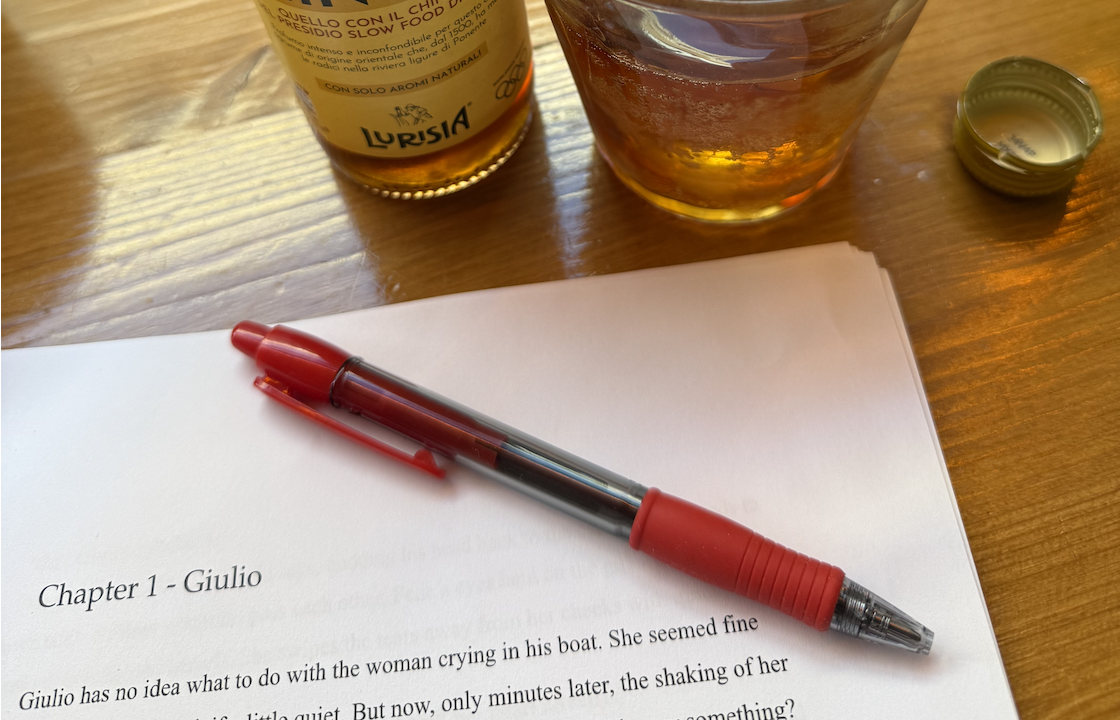
Self-editing doesn’t have to be scary. Get yourself a red pen and FEEL THE POWER!
Getting feedback
Every novel needs feedback before it hits the shelves, or agent’s inboxes. That’s non-negotiable. But what varies depending on every novel is what kind of feedback you get, and when.
There are four ways to get feedback, each with their pros and cons.
Giving it to family and friends
Pros: Feels safe, and they’re more likely to be encouraging.
Cons: They may not be your ideal readers, they may not have useful publishing knowledge, they may only tell you what’s good.Attending community feedback groups
Pros: They can give you advice with a writer’s eye, they can give you more actionable advice, they’re less likely to sugarcoat feedback.
Cons: Typically groups only review a chapter at a time — meaning it’ll take a long time to get your whole novel reviewed, and it doesn’t reflect the real reading experienceFinding dedicated beta readers
Pros: Vital for any publishing journey eventually, more reflective of the average reading experience, gives you a range of opinions.
Cons: Having conflicting, subjective opinions of your work can be confusing.Using professional editing services
Pros: Experienced and knowledgeable feedback based on deep craft and industry knowledge, slightly less subjective than general reader feedback, more in-depth advice on where to go next
Cons: Financial investment, finding the right editor requires research.
No two books require the exact same feedback journey, but let’s keep it simple. If you’ve just finished a round of edits on your first draft of your first completed novel. Here’s what I would do:
Give it to 2-3 friends who like the kinds of books you’ve written. If you’ve got a romance, giving it to your romance-hating friend might lead to some pretty deflating, misguiding feedback.
Condense their feedback into bullet points. Where do they agree? Where is there clearly a difference of opinions?
Optional: Self-editing round 2. If all of your readers point out the same glaring error (the one you’ve been pretending not to notice), go back into the draft and fix it, if you know how. Otherwise in the next stage you’re paying someone to tell you what you already know.
Hire an editor. Choose either a developmental edit, or a manuscript feedback service. Something high-level which gives you a similar list of bullet points to your readers, but based on professional knowledge rather than subjective opinion. This will focus on big things like plot, pace, character, and theme. Rather than fixing every line, you’ll get a roadmap for what the rest of the editing process should look like, and make sure you’re writing with your publishing goals in mind.
Working towards your publishing goals
You might decide to just get the book written, edited, and publishable, and then decide what to do with it. That is completely valid. But if you already know what you want to do with your novel, writing with your publishing goals in mind can save a lot of time and a lot of headaches.
Path 1: Traditional publishing
If you’re trying to get traditionally published, you don’t need to edit with solely the market in mind. Don’t drop your dark fantasy novel just because romantasy is hot right now, or make your unhappy ending happy because it’s a safer bet. Imagine how many unique voices we wouldn’t have if writers only wrote what they thought would sell.
However, writing with a traditional book deal in mind does change how you approach your manuscript. Agents and publishers are generally looking for:
A strong hook
First chapters that leave them asking questions and wanting more
Genre fiction that delivers on genre expectations, OR that artfully subverts them
A well-paced plot that keep readers turning the page all the way to the end
Characters that are believable, with complete arcs
When considering your novel, they need to see exactly where it fits on bookshop shelves. They need to know that there’s a demand for a story like yours, and that there are readers ready to put down cold hard cash for it. A book deal is a business deal, after all.
What that means for you: Work with a professional editor who understands the publishing industry. They can tell you where your novel’s genre expectations aren’t being met, where your opening chapters might lose the reader (and therefore the interest of agents and publishers), and even help you with things like your query letter and pitch package. You’re not re-writing your novel just to make the gatekeepers happy, but you should understand where your novel raises red flags and how to remove them.
What to get: A manuscript assessment, or a developmental edit
Path 2: Self-publishing
Self publishing is a different beast entirely, but it still follows pretty similar rules. Agents want great first chapters because readers want great first chapters. Thanks to things like Kindle Unlimited, it’s all too easy for a reader to download a free copy of your novel, and then DNF five pages in when they realise the writing is wonky. So you have to be your own agent, editor, and publishing house.
So, rather than writing with agents in mind and writing what the market wants, focus your energy on creating the best possible reading experience for your readers.
What that means for you: You won’t have the luxury of an in-house editing team. That’s good, because it gives you ultimate control and freedom over your story. But it’s also a challenge, because it means you’re in charge of getting your novel publish-ready. Every flat character arc, every plot hole, every spelling mistake…it’s all on you!
What to get: Skip the manuscript assessment, and go straight to the developmental edit, and then move on to line editing and proofreading.

Looking for an editor?
I offer friendly and bespoke editorial services, from the developmental edit that knocks your plot into shape, to the final proofread.
Path 3: Putting it away again
It’s quite rare that your first written novel will also be your first published novel. First novels are like the first pancake on Shrove Tuesday. The pan probably wasn’t quite hot enough, or you used a little too much batter, and what you’ve got is just a little…lumpy. Certainly not the best of what you’re capable of.
So, if other ideas are knocking it’s okay to put your first novel away and work on something else for a while. Many of your favourite writers have a drawerful of drafts.
Finding your dream editor
Just like there are many different kinds of writers, there are many different kinds of editors. Some specialise just in certain types of fiction, and some are generalists. Some have a no-nonsense approach best suited for veteran writers, and others have a softer-touch.
If you’re looking for an editor, here’s why I might be the one for you:
I tailor my editing services to you, whether you’re a first-time author with no idea of where to go next, or a veteran with a specific game-plan
I’m a generalist, meaning I work across genres, but I have a particular love for fantasy, romantasy, romance, contemporary, commercial/book club fiction, and “no plot, just vibes” stories
I’ve trained with the CIEP and the Institute of Publishing, and have a BA (Hons) in English Literature and Classical Studies
Thanks to my previous career in digital marketing, I can also help with self-publishing tasks like a great blurb, and give you advice on cover art and promo plans
My experience in the traditional publishing industry also means I can help you get your novel ready to query
If that peaks your interest, get in touch and request your free sample edit! Or if you’re still shopping, let’s connect on Instagram so you can keep me in your cart.
